
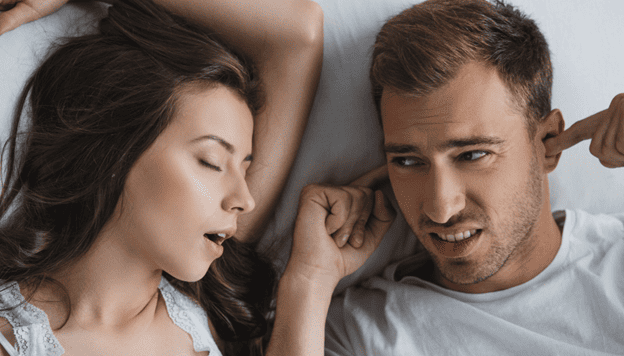
A person can snore for years without having obstructive sleep apnea. The concern changes when a partner begins noticing stretches of silence between snores, followed by gasping, choking, or a sudden return to breathing. Waking tired after a full night of sleep can add to the concern.
Snoring and obstructive sleep apnea (OSA) are related, but they are not interchangeable. Snoring comes from vibration within a narrowed upper airway. With OSA, airflow repeatedly decreases or stops during sleep because the upper airway becomes obstructed. These interruptions can disturb sleep and cause blood oxygen levels to fall.
The nose and throat are part of that airway, which is why an ENT may be involved in the evaluation. Dr. Mani H. Zadeh sees patients with snoring, nasal obstruction, and other upper-airway concerns in Los Angeles.
What Does Sleep Apnea Sound Like Compared With Snoring?
There is no single snoring sound that confirms sleep apnea.
Primary snoring may be steady for portions of the night. Breathing continues, even though airflow through the nose or throat causes tissue to vibrate. It can be loud enough to disturb a partner without causing repeated apnea events.
OSA can sound different because the breathing itself is being interrupted. A partner may hear loud snoring followed by a quiet period, then a gasp, snort, or choking sound as breathing resumes. Some people with OSA do not follow this recognizable pattern, however, and not everyone with the condition snores loudly.
What happens during sleep is more useful than judging the volume of the snoring.
Also Read: Can You Diagnose Sleep Apnea Just By Looking?
Five Signs That Snoring Needs More Attention
Your Partner Notices That Your Breathing Stops
Witnessed breathing pauses are among the more recognizable signs of possible sleep apnea. They may last only long enough for a partner to notice an unusual silence before breathing resumes.
The person experiencing the event often has no memory of it. If these pauses happen repeatedly, especially with gasping or choking, they warrant a medical evaluation.
You Sleep for Hours but Rarely Feel Rested
Someone with OSA may technically remain asleep for much of the night while still having disrupted sleep. Breathing events can trigger brief arousals as the body responds to an obstructed airway.
That can leave a person tired the next day despite having allowed enough time for sleep. Persistent sleepiness has many causes, but loud snoring and observed breathing changes give a physician an important reason to consider OSA.
Mornings Often Begin With a Headache or Dry Mouth
People with sleep apnea sometimes report morning headaches. Dry mouth is also common when nasal blockage or another issue leads to mouth breathing overnight.
These symptoms are not specific enough to diagnose a sleep disorder. They are more useful as pieces of a larger history, particularly when they occur with snoring, gasping, or poor-quality sleep.
The Snoring Has Become Uneven
A loud snorer does not necessarily have sleep apnea. The pattern may be more telling.
Long pauses, abrupt gasps, choking sounds, or repeated changes in breathing are different from continuous snoring. A recording made by a partner may help describe what has been happening, although a phone recording cannot take the place of a sleep study.
Daytime Function Is Starting to Change
Poor sleep can show up during the day as sleepiness, difficulty concentrating, irritability, or reduced alertness. OSA is also associated with hypertension and cardiovascular disease, which is why clinically significant sleep apnea is more than a bedroom inconvenience.
Symptoms such as fatigue and difficulty concentrating have many explanations. Their connection to OSA becomes more plausible when the nighttime history points in the same direction.
Primary Snoring and OSA Are Different Problems
The dividing line is not simply whether the snoring is loud.
| Primary Snoring | Obstructive Sleep Apnea | |
|---|---|---|
| Breathing | Air continues to move through the upper airway | Airflow repeatedly decreases or stops because of obstruction |
| Breathing pauses | Not characteristic | May occur repeatedly |
| Oxygen levels | Repeated apnea-related drops are not expected | May fall during obstructive events |
| Sleep | Snoring may be disruptive, but there are no repeated apnea events | Respiratory events can repeatedly interrupt normal sleep |
| What a partner may notice | Snoring without obvious pauses | Snoring interrupted by silence, gasping, choking, or snorting |
| How OSA is confirmed | OSA is excluded when clinically appropriate | Appropriate sleep testing is used to establish the diagnosis |
This distinction is difficult to make from symptoms alone. Someone can have significant OSA without dramatic nighttime sounds, while another person can be an extremely loud snorer and have no obstructive apnea.
Also Read: The Hidden Dangers of Obstructive Sleep Apnea
A Blocked Nose Can Make Nights Noisier
People who struggle to breathe through their nose during the day often notice the problem even more when they lie down.
A deviated septum is one possible reason. The septum divides the nasal passages, and a significant deviation can restrict airflow on one or both sides. The turbinates inside the nose can also become enlarged because of allergies, inflammation, or other conditions.
Reduced nasal airflow may encourage mouth breathing and contribute to snoring. Nasal obstruction also commonly exists alongside OSA.
It is tempting to assume that fixing the nose will therefore fix sleep apnea. Adult OSA is often more complicated. The airway can narrow or collapse behind the soft palate or tongue even when the nasal passages are open.
Treating meaningful nasal obstruction may still be valuable. Better nasal breathing can improve nasal symptoms and may make CPAP more comfortable for some patients. Whether septoplasty or turbinate treatment belongs in the plan should come from the nasal findings rather than the sleep apnea diagnosis alone.
Sometimes the Important Anatomy Is Farther Back
The airway changes when we fall asleep. Muscles relax, including those that help maintain space in the throat.
For someone with a relatively crowded upper airway, that change can become important. Enlarged tonsils, the shape of the soft palate, tongue position, jaw anatomy, and other physical features can affect the amount of room available for airflow.
An ENT can examine these areas for findings that may be relevant to snoring or obstruction. The examination does not show exactly what the airway does throughout an entire night of sleep, so anatomy is only one part of the assessment.
What Happens During an ENT Evaluation for Snoring?
The visit usually begins with the history behind the snoring. When did it start? Is nasal breathing difficult? Has anyone observed pauses or gasping? Is there significant daytime sleepiness? Has sleep apnea already been diagnosed?
The physical examination then gives those symptoms context. Dr. Zadeh can evaluate the nasal passages and upper airway for structural findings that could interfere with airflow.
When a closer look is useful, nasal endoscopy may be performed. A thin scope with a camera and light allows the physician to examine areas inside the nose that are difficult to see during a standard examination. Septal deviation, enlarged turbinates, inflammation, and other sources of nasal obstruction may become more apparent.
Endoscopy answers an anatomical question. It does not measure apnea events or establish how severe OSA is.
How Do You Find Out if You Actually Have Sleep Apnea?
A sleep study evaluates breathing while you are asleep.
For certain adults with symptoms suggesting OSA, home sleep apnea testing may provide the necessary information. A portable device records several aspects of nighttime breathing, typically including airflow, respiratory effort, and blood oxygen.
Sleeping in your own bed can make home testing convenient, but convenience is not the deciding factor. Some medical conditions and sleep problems call for a more comprehensive study in a sleep laboratory.
There is another limitation worth knowing. A negative home study does not always close the case. When symptoms still strongly suggest OSA, an in-laboratory sleep study may be appropriate.
This is also why a symptom checklist should not be used to diagnose yourself. Screening questions can identify reasons to investigate, but the diagnosis comes from the clinical evaluation and appropriate testing.
If the Problem Is the Septum, Will Septoplasty Stop the Snoring?
It may improve snoring when nasal obstruction is an important contributor, but there is no reliable way to promise that septoplasty will make snoring disappear.
Septoplasty straightens the portions of a deviated septum that interfere with nasal airflow. It treats the nasal obstruction itself. Turbinate reduction serves a different purpose by reducing enlarged turbinate tissue when that tissue is contributing to blockage.
Neither operation should be described as a standard cure for OSA.
For someone who has both nasal obstruction and sleep apnea, nasal treatment may make breathing through the nose easier. Some patients also find CPAP easier to use once significant nasal obstruction has been addressed. OSA occurring elsewhere in the airway may still require separate treatment.
What if CPAP Is Not Working Well?
CPAP remains an important and effective treatment for obstructive sleep apnea. Pressurized air delivered through a mask helps prevent the upper airway from closing during sleep.
Difficulty using CPAP does not necessarily mean the treatment itself is unsuitable. Mask fit, pressure settings, nasal congestion, dryness, and other practical issues can affect tolerance. A patient with substantial nasal obstruction, for example, may benefit from having the nasal problem evaluated rather than abandoning CPAP.
There are alternatives for some patients. Oral appliance therapy may be appropriate in certain cases, and selected patients may be considered for procedures directed at a specific area of obstruction. Weight management or positional treatment can also play a role when those factors are relevant.
The treatment choice should follow the diagnosis and the patient’s airway findings. Starting with a preferred procedure and trying to make the patient fit it reverses that process.
When Does It Make Sense to See an ENT?
Snoring alone can justify an evaluation when it is persistent or disruptive, particularly if nasal breathing is difficult. The case for medical evaluation becomes stronger when someone has seen you stop breathing or when snoring is accompanied by choking, gasping, or substantial daytime sleepiness.
An ENT visit is especially useful when the nose feels chronically blocked or there is reason to suspect a structural airway problem. Examining the nose and throat can show whether anatomy is contributing and whether treating that anatomy is likely to be useful.
When sleep apnea is suspected, the ENT examination and sleep study answer different questions. One looks at the airway. The other documents what breathing is doing during sleep.
Also Read: Sinus Surgery As a Cure for Sleep Apnea
Frequently Asked Questions
Can I Have Sleep Apnea if I Don’t Snore?
Yes. Snoring is common among people with OSA, but its absence does not rule the condition out. Symptoms, medical history, examination findings, and sleep testing provide a more reliable assessment.
Does Loud Snoring Automatically Mean Sleep Apnea?
No. People with primary snoring can be very loud. Pauses in breathing, gasping, choking, and excessive daytime sleepiness raise greater concern for OSA, but a sleep study is needed to confirm the diagnosis.
Can Dr. Zadeh Tell if I Have Sleep Apnea During an Office Exam?
An ENT examination can identify nasal or throat anatomy that may contribute to airway obstruction. It cannot determine how often breathing stops during sleep or establish OSA severity. Those questions require appropriate sleep testing.
Can a Deviated Septum Make Sleep Apnea Worse?
Significant nasal obstruction can make nighttime breathing more difficult and may complicate CPAP use. A deviated septum can therefore be relevant to the overall treatment plan, although it is rarely the only factor responsible for adult OSA.
Will Septoplasty Cure My Sleep Apnea?
Septoplasty is performed to improve nasal airflow when the septum is causing obstruction. It is not considered a universal cure for obstructive sleep apnea. Patients who have OSA may continue to need CPAP, an oral appliance, or another treatment after nasal surgery.
Why Does My Snoring Get Worse When My Nose Is Congested?
Congestion restricts nasal airflow and often encourages breathing through the mouth. That change can increase snoring in some people, particularly when the upper airway is already narrow.
Is Snoring Harmful if a Sleep Study Shows I Don’t Have OSA?
Primary snoring does not have the same established health consequences as OSA. It can still disturb sleep for the person snoring or a bed partner, and nasal obstruction or another treatable problem may be contributing to it.
Are Morning Headaches a Sign of Sleep Apnea?
They can occur with OSA, but morning headaches have many possible causes. They are more suggestive when the rest of the history includes loud snoring, witnessed apnea, gasping, or significant daytime sleepiness.
Can Enlarged Tonsils Cause Sleep Apnea in Adults?
Large tonsils can reduce space in the upper airway and contribute to OSA in some adults. Their importance is considered along with the rest of the airway anatomy and the results of sleep testing.
What Happens if My Home Sleep Apnea Test Is Normal but I Still Have Symptoms?
Persistent symptoms may justify additional evaluation. When a home study is negative or inconclusive and OSA is still suspected, an in-laboratory sleep study may be recommended.
Do I Need to See a Sleep Specialist or an ENT?
That depends on what needs to be evaluated. Sleep medicine focuses on diagnosing and managing sleep disorders, while an ENT can assess structural problems affecting the nose and upper airway. Many patients benefit from both perspectives rather than treating them as competing options.
How Do I Schedule a Snoring and Sleep Apnea Consultation With Dr. Mani H. Zadeh?
Contact Dr. Mani H. Zadeh’s Los Angeles office directly or request an appointment online.
Find Out What Is Happening While You Sleep
Snoring becomes more informative when it is considered alongside everything else that is happening at night and the following day. A blocked nose points toward one set of questions. Repeated breathing pauses, gasping, or persistent daytime sleepiness raise another.
Dr. Mani H. Zadeh evaluates the nasal passages and upper airway to identify structural problems that may be affecting nighttime breathing. If the history suggests obstructive sleep apnea, sleep testing can determine whether breathing is actually being interrupted and help guide treatment from there.
Contact Dr. Zadeh’s Los Angeles office to schedule an evaluation for persistent snoring, nasal obstruction, or concerns about nighttime breathing.
This article provides general medical information and is not a substitute for individual medical care. Snoring, fatigue, headaches, and other sleep-related symptoms can have several causes. Diagnosis and treatment should be based on an individual’s history, examination, and appropriate testing.